
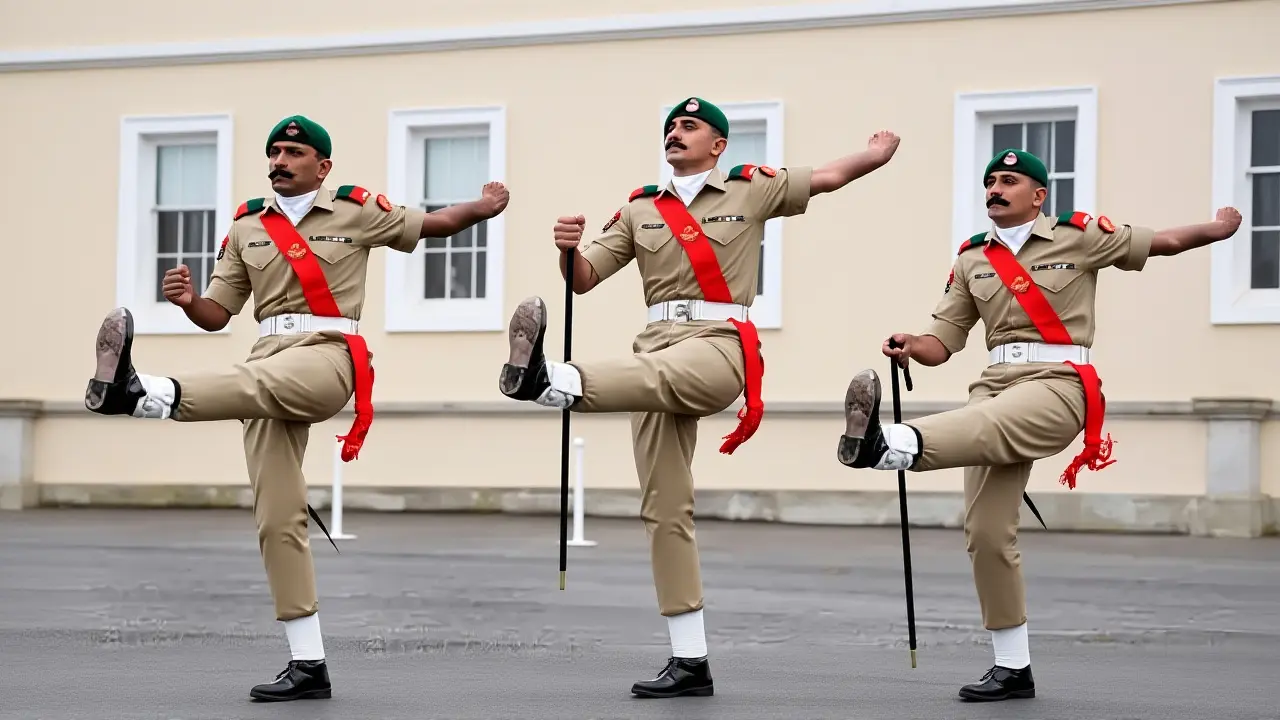
It’s the kind of discipline that makes you hold your breath. At Royal Military Academy Sandhurst, soldiers from around the world gathered not for combat training, but for something arguably harder: perfect, silent synchronisation. The event, billed as a global precision drill contest, turned the historic grounds into a stage where milliseconds mattered more than miles.
Here’s the thing about precision drill—it looks effortless until you try it. One wrong step, one delayed snap of a rifle butt, and the entire illusion shatters. According to coverage by BBC Berkshire, the atmosphere was electric yet tense. Teams didn’t just march; they performed choreographed routines designed to test the absolute limits of human coordination.
The Mechanics of Perfection
The structure of the competition is deceptively simple. Each team consists of exactly four soldiers. But don’t let the small number fool you—the complexity scales exponentially with every movement. As reported in outlets like AOL, each squad has one member designated as the "driver." This isn’t a vehicle operator; this soldier leads the formation, setting the tempo and spatial awareness for the rest of the group.
The objective? "As perfect synchronisation as possible." That phrase does a lot of heavy lifting. In practical terms, it means that when the team turns, they turn on the same axis. When they halt, their boots hit the ground in a single, thunderous crack. There are no verbal commands during the routine. The only sounds allowed are the sharp *snap* and *pop* of rifles moving through complex patterns, timed precisely to music or internal rhythm.
Think of it like a quartet playing jazz without speaking. Everyone knows the song, everyone listens to everyone else, and if one person rushes, the whole piece falls apart. The "driver" acts as the conductor, but unlike an orchestra, there’s no baton—just body language and years of drilled instinct.
Why Sandhurst?
Holding this contest at Sandhurst carries weight. It’s the premier officer training academy for the British Army, located in Berkshire. For decades, it has been synonymous with leadership development and tactical excellence. Hosting a global drill contest here signals that precision isn’t just about looking good; it’s a fundamental indicator of unit cohesion and command presence.
While the specific list of participating nations wasn’t fully detailed in initial reports, the term "global" suggests international representation. We know from similar events that units often come from allied forces, cadet corps, and specialized police units. The presence of ranks like Lance Corporal (L/Cpl) among competitors indicates that these aren’t necessarily high-ranking officers, but junior leaders honing their ability to influence others through example rather than authority.
The Art of the Drill
To understand what these soldiers are doing, it helps to look at the broader context of precision drill. In places like Singapore, the Singapore Armed Forces Military Police Command has made precision drill a signature art form. Their squads perform intricate rifle tosses and spins, moving in unison through geometric patterns.
While the Sandhurst contest may have focused more on traditional marching drills rather than acrobatic rifle handling, the core principle remains identical: control under pressure. The soldiers must maintain rigid posture while executing rapid changes in direction. Their eyes stay forward, their minds stay locked on the driver, and their bodies move as a single organism.
This isn’t just theater. In military history, the ability to maneuver large groups quickly and quietly has saved lives. A unit that can change formation in silence is a unit that can ambush, retreat, or advance without giving away its position. The contest strips away the weapons and tactics to focus purely on the foundational skill: unity of action.
What We Still Don’t Know
Oddly enough, despite the visual spectacle, some key details remain elusive. The exact date of the event isn’t explicitly pinned down in early social media posts, though the timing aligns with typical autumn training cycles at Sandhurst. We also lack the final scoreboard. Which team achieved the "perfect" sync? How many teams competed in total? These answers might emerge in follow-up reports, but for now, the mystery adds to the allure.
Experts suggest that judging criteria likely include alignment, timing, bearing, and the crispness of movements. A fraction of a second delay in a salute can cost points. A slight lean in the shoulder line can break the visual flow. It’s brutal in its simplicity.
Broader Impact on Military Training
Why do militaries invest time in such seemingly ceremonial activities? Because trust is built in the details. When four soldiers move as one, they demonstrate a level of mutual reliance that translates directly to battlefield effectiveness. If you can trust your teammate to step left at the exact moment you do, you can trust them to cover your flank under fire.
Furthermore, these contests foster camaraderie across borders. Soldiers who compete together often build relationships that outlast the event. In an increasingly fragmented geopolitical landscape, shared professional standards and mutual respect for discipline serve as subtle diplomatic bridges.
What’s Next for Precision Drill?
As digital distractions grow, the appeal of analog perfection might actually increase. Future editions of the contest could see even greater technological integration in judging—using sensors to measure millisecond differences in footfalls. But the human element will remain central. No algorithm can replicate the sheer willpower required to keep your face impassive while your lungs burn and your legs ache.
For now, the image of those four soldiers standing still, rifles aligned, serves as a powerful reminder of what disciplined focus looks like. It’s a lesson in patience, practice, and partnership that resonates far beyond the parade ground.
Frequently Asked Questions
What is the role of the "driver" in a precision drill team?
The driver is the lead soldier within a four-person team who sets the pace, direction, and timing for the entire group. Unlike other members who follow visual cues, the driver initiates movements, ensuring that the team maintains perfect synchronization without verbal commands. This role requires exceptional spatial awareness and confidence.
Why is Royal Military Academy Sandhurst hosting this contest?
Sandhurst is the United Kingdom's primary officer training academy, renowned for its emphasis on leadership and discipline. Hosting a global precision drill contest there underscores the importance of these skills in military professionalism. It provides a prestigious venue that attracts international participants and highlights the heritage of British military tradition.
How is precision drill different from standard marching?
Standard marching focuses on basic formation and movement efficiency. Precision drill elevates this to an artistic and technical level, requiring millisecond-perfect synchronization, complex choreography, and often the use of rifles in coordinated maneuvers. The goal is not just to move, but to create a visually seamless performance that demonstrates extreme unit cohesion.
Are there any known winners or results from this specific contest?
Currently, specific results, including winning teams or scores, have not been publicly released in the available reports. Initial coverage focused on the participation and the nature of the competition rather than the final standings. Detailed outcomes may be published later by organizing bodies or military press offices.
Does this contest involve actual combat training?
No, the contest is strictly a display of drill proficiency and synchronization. While the skills developed—such as situational awareness, discipline, and teamwork—are transferable to combat scenarios, the event itself is ceremonial and competitive in nature, focusing on precision and aesthetics rather than tactical engagement or weaponry use.